It’s strange to think that VAR was implemented in football less than ten years ago. Popularly known as “video referee,” the resource was seen as a necessity in the sport due to the many scandals that occurred, as well as the example of other sports, such as volleyball and American football, which had already adopted similar practices for use during games. 100Percentsurewins ! tells you about when VAR started.
When was VAR first used?
VAR began being used on August 12, 2016, in the game between Orlando City II and New York Red Bulls II, in the third major league of the sport in the United States, marking the first official match in which the technology was used.
On that occasion, referee Ismail Elfath, who was the protagonist of the new event, had to appear on screen twice. The first play that resulted in a review was a penalty correction for Orlando City II. The second review occurred when a yellow card was given to an Orlando player.
What generated curiosity when VAR first started being used was the improvisation in how the tool was implemented. Since a video referee booth as we know it today didn’t yet exist, an assistant referee held the monitor off the field. Furthermore, because it was tested in a third division match, the fact also generated little media attention and publicity.
Why was VAR implemented?
The debate over whether or not VAR should be developed began moments before the 2010 World Cup, in a qualifying match between France and Ireland. In that game, striker Thierry Henry handled the ball, providing an assist for Gallas to score the equalizing goal and qualify France for the World Cup.
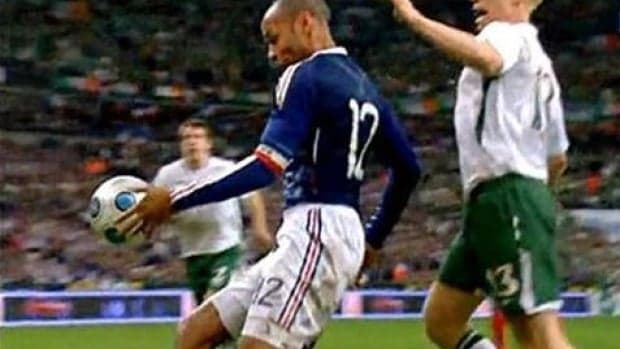
Besides this refereeing error, two others became very famous and, as they happened in major championships with global audiences, made FIFA and the International Board open their eyes to the implementation of the system. The first, still in the 2010 World Cup, when a legitimate goal by Frank Lampard against Germany was not validated, even though the ball crossed the goal line well above the goal line. The other happened in the 2012 European Championship, when Ukraine had a goal disallowed for the same reason, against England.
“Goal Line Technology” is born
These three errors occurred within a very short timeframe, which sparked discussions about a technology to assist referees. Thus, “Goal Line Technology,” or simply goal-line technology, was developed to always mark when the ball crossed the goal line, preventing similar incidents to those at the 2010 World Cup from happening again.
As soon as Gianni Infantino took over as FIFA president, he authorized video referee testing in six countries, including Brazil and the USA. The technology was actually used for the first time in a friendly match in the Netherlands, but it only officially debuted in a United Soccer League match, as the United States was already more accustomed to this system.
After almost ten years since its first use, it’s very difficult to imagine a scenario in football without VAR. Even with its implementation, debatable plays still occur, but deliberate and scandalous refereeing errors seem to have been left behind, or at least are much rarer than we saw before the tool was created.
When did VAR start in Brazil?
The final of the 2017 Pernambuco Championship, between Salgueiro and Sport, went down in history as the first Brazilian football match to feature VAR. In national competitions, the CBF implemented VAR from the quarter-finals of the 2018 Copa do Brasil. In South American competitions, CONMEBOL also implemented VAR from the quarter-finals of the 2018 Libertadores and Sudamericana.
In the Brazilian Championship, the first game with VAR only happened in the first round of the 2019 edition, in the match São Paulo 2 x 0 Botafogo.