

2026 Winter Olympics Medal Count Predictions: Early Insights and Expert Analysis
Why the 2026 Winter Olympics Medal Count Predictions Matter More Than Ever
If you follow winter sports even a little bit, you already know one thing. The 2026 Winter Olympics medal count predictions are not just casual guesses thrown around by fans on social media. They shape expectations, influence betting trends, drive national pride, and honestly, spark debates that last for years. And if you are here at 100percentsurewins.com, chances are you care about getting ahead of the curve.
So why does the 2026 Winter Olympics medal count predictions conversation feel bigger this time around?
First, the competitive gap between top nations is shrinking. In past Winter Games, you could almost pencil in Norway or Germany near the top and move on. But now? Athlete development programs have expanded globally. Technology in training has improved. Sports science is no longer reserved for the traditional powerhouses. Countries that barely cracked the top fifteen a decade ago are now consistently grabbing podium spots.
Second, the betting landscape has evolved massively. Medal totals are not just about bragging rights anymore. They are tied to complex futures markets, head to head national comparisons, and discipline specific predictions. Understanding likely medal distributions gives bettors a real edge.
And let’s be honest. There is something addictive about trying to forecast greatness. Who peaks at the right time? Which rising star explodes onto the scene? Which defending champion quietly fades?
The 2026 Winter Olympics in Milan Cortina adds another layer. A European host. Historic venues. Travel logistics. Altitude differences. All of these tiny details can tilt medal outcomes.
That is why we are not guessing here. We are digging into trends, athlete pipelines, and realistic performance curves to bring you grounded 2026 Winter Olympics medal count predictions that actually make sense.
Because when the torch is lit in Italy, the smart fans will already know what is coming.
The Unique Landscape of the 2026 Winter Olympics in Milan Cortina
The 2026 Winter Olympics will not look like your typical Games. Milan Cortina offers something different. It is not a single compact Olympic village surrounded by snow covered mountains. Instead, events will stretch across multiple iconic Italian regions. That geographic spread matters more than most people realize.
Altitude plays a quiet but powerful role in winter performance. Some venues sit higher, favoring athletes trained in mountainous environments. Others are at lower elevations, which can impact endurance sports like cross country skiing and biathlon. Nations like Norway and Switzerland naturally train in similar conditions. That could give them a subtle edge.
Travel between venues will also test teams. Logistics become part of performance. The ability to recover, adapt, and maintain peak condition across dispersed locations is not something you can quantify easily, but it absolutely influences medal outcomes.
Then there is the home nation factor. Italy will not just host. It will feed off the energy. Historically, host nations outperform their average medal counts. Look back at previous Winter Games and you will notice a pattern. Familiar terrain, supportive crowds, and reduced travel stress often translate into a few extra podium finishes.
Another factor that makes the 2026 Winter Olympics medal count predictions tricky is the expansion of events. More medal opportunities mean more volatility. Freestyle skiing and snowboard disciplines continue to grow. Mixed team events are increasing. That benefits nations with deep rosters rather than just one or two superstars.
And let’s not ignore weather unpredictability. European winters can be inconsistent. Artificial snow helps, but temperature swings can affect surface conditions, especially in alpine skiing and sliding sports.
All of this creates a Games that feels wide open. Traditional powerhouses will still dominate. But the margins might be thinner than ever.
How Medal Count Predictions Influence Betting Markets and Fan Expectations
If you think medal predictions are just for sports talk shows, think again. They directly shape betting lines, futures markets, and national prop bets. For a platform like 100percentsurewins.com, understanding 2026 Winter Olympics medal count predictions is about finding edges before the public catches on.
Here is how it works.
Oddsmakers release early projections based largely on past performance and global rankings. Casual bettors pile onto big name countries like the United States, Norway, or Canada. That public money shifts lines. But sharp bettors look deeper. They study injury reports. They analyze youth championship results. They track World Cup consistency over multiple seasons.
For example, if a country has aging champions who dominated in 2022 but have shown decline in recent seasons, betting their over on medal totals might be risky. On the flip side, if a nation has several under twenty three athletes consistently finishing top three in World Cup events, that is a sign of an incoming surge.
Fan expectations also matter psychologically. Athletes from countries with massive medal pressure sometimes struggle under the weight of expectations. Smaller nations often compete with less stress, which can produce surprise podium finishes.
There is also the team event factor. Ice hockey, mixed relays, and team pursuit races swing multiple medals in one go. One upset can dramatically alter national standings.
That is why smart analysis of 2026 Winter Olympics medal count predictions is not about guessing who wins the most gold. It is about understanding distribution. Which country racks up silvers and bronzes? Who dominates specific clusters of events? Where are the realistic vulnerabilities?
Because in the end, the medal table is not random. It is built event by event, decision by decision, moment by moment.
And the earlier you see the patterns, the better positioned you are.
Methodology Behind Our 2026 Winter Olympics Medal Count Predictions
When people throw around 2026 Winter Olympics medal count predictions, most of them are guessing. Some are leaning on patriotism. Others are just repeating what happened in 2022 and assuming history will copy and paste itself. But if you actually want to build authority and make projections that hold weight, you need a real framework.
So here is how we approach it at 100percentsurewins.com.
First, we break down historical medal patterns over the last four Winter Games. Not just total medals, but distribution by sport. Which countries consistently dominate sliding sports. Who owns the biathlon circuits. Which nations are climbing in freestyle disciplines. Trends matter more than one good year.
Second, we look at World Cup results from 2023 through 2025. These are not random tune up events. They are the clearest indicators of Olympic readiness. Athletes who consistently podium in World Cup circuits usually convert that form into Olympic medals. Of course there are surprises, but consistency is rarely accidental.
Third, we analyze age curves. Winter sports often reward experience, but not always. Alpine skiing tends to peak mid to late twenties. Snowboard and freestyle events often skew younger. If a country’s medal hopes are mostly athletes over thirty two, that is a small red flag. If they have a pipeline of twenty one year olds already beating veterans, that is a green light.
Fourth, we factor in host nation advantage. Italy is expected to exceed its recent medal averages simply because of familiarity and crowd energy. History supports this.
Finally, we adjust for volatility. Team events, weather sensitive sports, and judged competitions introduce unpredictability. We do not overproject gold medals in those categories because margins are razor thin.
This layered approach makes our 2026 Winter Olympics medal count predictions grounded rather than emotional. It is not perfect. Nothing is. But it is structured, data informed, and realistic.
And that is what separates a smart projection from a hopeful guess.
Historical Performance Trends from Previous Winter Games
Let’s talk patterns. If you want to forecast the 2026 Winter Olympics medal count predictions properly, you have to understand what the last decade tells us.
Norway has been a machine. In 2018 and 2022, they dominated the medal table with depth in cross country skiing, biathlon, and Nordic combined. This was not a fluke. It was built on a development system that feeds talent continuously. When one star retires, another steps up.
Germany has quietly maintained elite status, particularly in sliding sports like bobsleigh, luge, and skeleton. Their technical precision and investment in track technology keep them competitive year after year. Even when their alpine results fluctuate, their sliding dominance stabilizes their medal count.
The United States has shown a different profile. They excel in freestyle skiing, snowboarding, and certain ice sports. However, their medal totals can swing depending on performance in alpine skiing and speed skating. The US is explosive in certain categories but less consistent in endurance disciplines.
Canada consistently performs in ice hockey and has improved significantly in freestyle skiing. They are less dominant in cross country compared to Norway but compensate with strong showings in team sports.
One interesting trend is the rise of smaller European nations. Sweden, Switzerland, and the Netherlands have carved out specific niches. The Netherlands in speed skating, Switzerland in alpine skiing, Sweden in biathlon and cross country. Specialization matters.
Another shift is the growing importance of mixed team events. Countries with depth across genders benefit more than those reliant on one superstar.
Looking at these patterns, the 2026 Winter Olympics medal count predictions suggest that traditional leaders will remain strong, but gaps between ranks one and five could narrow. We are likely to see a tighter race at the top.
And tight races mean opportunity for smart analysis.
Athlete Development Cycles and Emerging Talent
Every Olympic cycle has a rhythm. Some countries peak too early. Others rebuild quietly and explode at the right moment. When creating serious 2026 Winter Olympics medal count predictions, you have to read those cycles correctly.
Take Norway. Their current roster includes both experienced champions and a wave of younger athletes already winning World Cup events. That balance is dangerous for competitors. It suggests sustained dominance rather than decline.
The United States is seeing a youth surge in snowboard and freestyle skiing. Several athletes under twenty three are already landing complex tricks under pressure. That usually translates well to Olympic formats, especially in slopestyle and halfpipe events where innovation wins medals.
Canada is developing a strong pipeline in women’s hockey and freestyle skiing. Their junior programs have consistently produced podium finishers at youth world championships. That is not random. It signals upcoming Olympic depth.
Germany’s sliding programs continue to groom technical specialists from a young age. Their talent identification system is extremely structured. This means their bobsleigh and luge medal chances remain stable heading into 2026.
Italy is the interesting case. As host nation, funding and training intensity increased post 2022. Young Italian alpine skiers and short track athletes are showing upward momentum. Hosting often accelerates development programs. That could translate into a medal bump.
What you learn from this is simple. Countries with balanced age distribution and strong youth results rarely collapse at the Olympics. Countries relying heavily on aging legends often see sharp medal drops.
And when building medal count projections, sustainability beats nostalgia every time.
Home Advantage and Environmental Factors
Home advantage is real. It is not just about cheering crowds. It is about familiarity with snow texture, course layout, and even food and recovery routines. Italy hosting the 2026 Winter Olympics changes the equation.
Historically, host nations increase medal totals by a noticeable margin. Look at Canada in 2010. Look at Russia in 2014. The pattern is consistent. Infrastructure investment peaks. Athlete preparation intensifies. Qualification processes align with maximizing representation.
Italy traditionally sits outside the top three in overall medal tables. But with home ice and home slopes, their 2026 Winter Olympics medal count predictions show clear upside potential.
Environmental familiarity also plays into Nordic and alpine events. European nations accustomed to similar mountain terrain may adapt quicker than teams traveling from lower altitude training centers.
However, home pressure can cut both ways. Expectations can weigh heavily. Athletes sometimes tighten up in front of home crowds. So while we project a medal increase for Italy, we do not expect an unrealistic leap into overall dominance.
Environmental factors extend beyond the host nation. Weather volatility in Europe may create shifting snow conditions. Athletes adaptable to changing surfaces have an edge. Nations with deep coaching staff and advanced analytics often adjust strategies mid competition.
In short, location matters. And when building 2026 Winter Olympics medal count predictions, ignoring geography would be a mistake.
United States Medal Count Predictions for 2026
Now let’s get specific.
The United States consistently ranks among the top nations in Winter Olympics medal tables, but their distribution is uneven. For the 2026 Winter Olympics medal count predictions, we project the US finishing between third and fifth overall, depending on ice hockey outcomes.
Strength areas remain freestyle skiing and snowboarding. These disciplines offer multiple medal events, and the US has both depth and innovation. Expect several podium finishes in slopestyle, halfpipe, and big air.
Figure skating also provides realistic medal opportunities, especially in team events. The US traditionally fields technically strong skaters capable of consistent scoring.
Speed skating and short track are more volatile. The US has talent but faces strong Dutch and Asian competition. A couple of medals here are likely but not guaranteed.
Ice hockey is the swing factor. If both men’s and women’s teams medal, total counts rise quickly. If one underperforms, projections tighten.
Overall projected range for the United States is approximately twenty two to twenty eight total medals, with gold medal count dependent on conversion efficiency in freestyle finals.
That places them firmly in the elite tier, but not necessarily at the very top.
Strength in Snowboarding and Freestyle Skiing
This is where the United States can really stack medals. Snowboarding and freestyle skiing are medal rich categories. One strong athlete can compete in multiple events.
The US development pipeline in these sports is arguably the best in the world. Training facilities, sponsorship structures, and competitive circuits allow athletes to peak at young ages. That matters because these events reward creativity and risk taking.
Look at recent World Cup seasons. American athletes consistently land on podiums in halfpipe and slopestyle. Depth is not limited to one star. There are multiple contenders capable of advancing to finals.
In terms of 2026 Winter Olympics medal count predictions, we estimate that the United States could earn between seven and ten medals combined across snowboard and freestyle disciplines alone. That is a huge chunk of their overall total.
However, judged sports carry unpredictability. One small error in landing. One under rotation. One scoring controversy. Gold can turn into bronze instantly. That is why we project a range rather than a fixed number.
Still, if you are looking for the backbone of the US medal count in 2026, this is it. High risk. High reward. And plenty of opportunity.
Ice Hockey and Figure Skating Medal Hopes
Ice hockey is a medal swing event for the United States. Both the men’s and women’s teams have realistic chances, but the competition is fierce. Canada, Sweden, Finland, and Russia traditionally dominate. A single upset can drastically alter the medal table. For the 2026 Winter Olympics medal count predictions, if Team USA can secure at least one gold between the men’s and women’s tournaments, it could push the United States closer to a top three overall finish. Even a silver or bronze in one category can make a noticeable difference in total medal count.
Figure skating is a discipline where the US has consistently produced stars, especially in women’s singles and pairs. Team events, introduced in recent Olympics, further enhance medal potential. Athletes like reigning world champions and new rising talents can contribute to both silver and gold medal prospects. Figure skating is unpredictable because judging can swing outcomes, but historical performance suggests the United States will likely claim multiple podium finishes. In terms of total medal contribution, we expect around three to five medals from figure skating events.
Combining ice hockey and figure skating, these disciplines give the United States a strong foundation beyond snowboarding and freestyle skiing. Success here is critical to pushing overall medal projections closer to 25. Performance in these team and judged events is less about individual dominance and more about strategic preparation and mental toughness. These are areas where the US historically excels and are key to understanding 2026 Winter Olympics medal count predictions.
Norway Medal Count Predictions for 2026
Norway has dominated Winter Olympics medal tables for several cycles. Known for unparalleled performance in Nordic sports, cross country skiing, and biathlon, Norway is projected to maintain its top position. The depth of their teams across multiple events ensures a consistent medal haul. For 2026, our predictions suggest Norway will secure between 30 and 36 total medals, potentially matching or slightly exceeding previous performances depending on emerging talent and injury factors.
Norway’s advantage lies not just in experience but also in their structured development programs. Young athletes are consistently trained in conditions that mirror Olympic venues. This produces an unusually high conversion rate from World Cup victories to Olympic medals. Additionally, Norway’s investment in sports science, nutrition, and recovery has elevated their athletes above many competitors. While the US and Germany may have standout performers, Norway’s depth ensures multiple medal opportunities across each discipline.
The primary risk factor for Norway is weather or course variability in Milan Cortina. Unpredictable snow conditions can impact endurance events like cross country skiing. However, Norwegian athletes are trained to adapt, making them resilient against such disruptions. Therefore, our 2026 Winter Olympics medal count predictions rank Norway as the team to beat, with realistic potential to finish first in both total medals and gold medals.
Dominance in Cross Country Skiing and Biathlon
Cross country skiing and biathlon are Norway’s bread and butter. Decades of investment in training facilities, coaching, and athlete pipelines have given them an edge that is difficult for competitors to match. The country routinely produces athletes capable of winning multiple medals per Games, including in sprint and long distance events. Our projections indicate that Norway could claim up to 12 medals just in these two disciplines, a substantial portion of their total medal count.
In biathlon, precision shooting under physical stress requires consistent training. Norwegian biathletes dominate world rankings, giving them an edge in both individual and relay events. The integration of technology in training, such as advanced wind simulations and heart rate monitoring, allows them to prepare for every possible condition they might face in Milan Cortina.
Cross country skiing benefits from Norway’s extensive national network of trails, which are meticulously groomed to match Olympic standards. Young athletes train in realistic conditions from an early age, creating continuity and depth. Even if one star underperforms, replacements are ready to step up, maintaining Norway’s competitive advantage. The 2026 Winter Olympics medal count predictions rely heavily on sustained dominance in these two sports, which are virtually guaranteed sources of multiple medals.
Norway’s Depth Across Winter Disciplines
While Nordic sports are Norway’s specialty, the country also maintains strength in ski jumping, freestyle skiing, and speed skating. This multifaceted depth ensures that medal count predictions are not overly dependent on a single discipline. Ski jumpers and speed skaters provide additional opportunities to accumulate medals, even if cross country and biathlon deliver the lion’s share.
Norway’s approach emphasizes team depth and redundancy. Multiple athletes can reach finals in a single event, which increases the likelihood of podium finishes. For example, in ski jumping, having several top contenders reduces the risk of an entire discipline underperforming. Similarly, in freestyle skiing, Norwegian athletes have steadily improved in slopestyle and halfpipe competitions, increasing the probability of additional medals.
The strategic benefit of depth is clear. Countries with only one or two standout stars can be vulnerable to injury or poor performance. Norway’s broad talent base ensures stability, which is crucial when projecting 2026 Winter Olympics medal counts. The combination of elite specialization and diverse competence makes them a formidable contender across the board.
Canada Medal Count Predictions for 2026
Canada consistently ranks among the top Winter Olympics nations. The country excels in ice hockey, speed skating, and freestyle skiing. Our projections suggest a total medal range of 25 to 30, with a realistic gold medal haul of 8 to 12 depending on performance in high-impact team events. Canada benefits from depth in specific disciplines and emerging talent pipelines that support consistent podium finishes.
Ice hockey remains a cornerstone for Canada. Winning gold in either men’s or women’s tournaments significantly boosts overall medal totals. In addition to team events, individual medals in speed skating and freestyle skiing supplement the total. Canadian athletes have shown strong form in World Cup competitions leading up to 2026, increasing confidence in medal projections.
Canada’s alpine skiing and snowboarding programs are also noteworthy. Young athletes in freestyle skiing, particularly in halfpipe and slopestyle, have begun surpassing expectations in international competitions. This suggests Canada could earn multiple medals in disciplines that have previously been less dominant. Considering these factors, Canada is positioned to remain in the top five overall nations in the 2026 Winter Olympics medal table.
Ice Hockey Expectations for Team Canada
Ice hockey is more than a sport in Canada. It is a national identity. Both men’s and women’s teams have extensive preparation cycles and access to elite training resources. Team Canada is expected to contend for gold in one or both tournaments. Success here is critical to 2026 Winter Olympics medal count predictions because each gold carries a disproportionate impact on total standings.
Men’s ice hockey has historically been tightly contested with countries like the United States, Sweden, Finland, and Russia. Any upset could significantly affect Canada’s medal projections. The women’s team, on the other hand, has been more dominant in recent cycles. A podium finish is highly likely, further boosting Canada’s total medal count.
Preparation strategies emphasize endurance, tactical flexibility, and high-pressure performance. Canadian teams participate in extensive international friendlies and pre-Olympic tournaments to refine lineups. This preparation maximizes their chances to convert potential into actual medals. For 2026, ice hockey is expected to contribute at least two gold or silver medals to Canada’s overall tally.
Canada’s Rising Stars in Alpine and Freestyle Events
Beyond ice hockey, Canada’s medal hopes rely heavily on freestyle skiing, snowboarding, and alpine events. Over the last few seasons, several young Canadian athletes have broken through on the World Cup circuit. Many of these competitors are under twenty-five, which means they are entering their athletic prime just in time for Milan Cortina. For 2026 Winter Olympics medal count predictions, these athletes could provide anywhere from five to eight additional medals if they maintain form and avoid injuries.
Freestyle skiing events like slopestyle, big air, and halfpipe have become Canada’s sweet spot. Canadian athletes are consistently innovating tricks, which gives them a competitive advantage. Snowboard events follow a similar trend. Depth is not limited to one superstar. Canada has multiple athletes capable of landing podium finishes, making their total medal count less dependent on a single performance.
Alpine skiing offers potential for surprise medals. Historically, Canada has not dominated in this discipline, but young skiers are showing promise in downhill and giant slalom events. With home-style preparation and European familiarity, Canadians could exploit weaker competition to capture unexpected podiums.
Combined, these rising stars mean Canada is positioned not just for traditional medals in team sports, but for individual events that can elevate overall standings. Analysts projecting 2026 Winter Olympics medal count predictions are paying close attention to these breakout athletes because their performances can shift national rankings dramatically.
Germany Medal Count Predictions for 2026
Germany has historically excelled in winter sports where precision and technique dominate. Bobsleigh, luge, skeleton, and speed skating are their signature events. For 2026 Winter Olympics medal count predictions, Germany is expected to remain a strong contender, projected to earn approximately twenty to twenty-five medals, with a significant number of golds coming from sliding sports and biathlon.
Germany’s consistent approach combines elite training infrastructure, strong national coaching systems, and a deep talent pipeline. In sliding sports, German athletes often dominate qualifying rounds and maintain top performance under pressure. This reliability makes them a dependable source of gold medals.
Beyond sliding, Germany also performs well in biathlon and speed skating. These events rely on both endurance and technical precision, and German programs emphasize consistency in international competition. While they may not match Norway’s depth in cross country skiing or the US’s flair in freestyle skiing, Germany’s focused excellence ensures multiple podium finishes.
Finally, Germany’s mid-range projected medal total reflects both specialization and breadth. While they are not as explosive as some nations in terms of medal volume, their precision in key disciplines ensures that their 2026 Winter Olympics medal count predictions are solid and credible.
Sliding Sports Powerhouse Performance
Germany’s dominance in bobsleigh, luge, and skeleton cannot be overstated. Historically, they claim multiple medals per discipline, often sweeping podiums. Advanced sled technology, aerodynamics research, and meticulous track preparation provide them with a tangible competitive edge. For 2026, analysts predict Germany will secure between six and nine medals just in sliding sports alone.
The technical aspects matter. Germany invests in high-speed sled testing and aerodynamic optimization that other nations struggle to match. Athletes also undergo rigorous simulation training, ensuring familiarity with varied track conditions. This preparation has translated to near-perfect medal conversion rates in previous Winter Games.
The result is predictability and reliability. For those tracking 2026 Winter Olympics medal count predictions, Germany’s sliding program provides a stable foundation for the national medal tally. Even if other events underperform, sliding sports are a near guarantee of podium finishes.
Consistency in Biathlon and Speed Skating
Biathlon and speed skating are Germany’s next pillar. German biathletes have consistently secured multiple podium finishes at World Cups, demonstrating technical and endurance prowess. Speed skating relies on precision, pacing, and strategy, areas where German athletes excel due to sophisticated analytics and advanced coaching methods.
For 2026, Germany could realistically add six to seven medals from these two disciplines. While they may face stiff competition from Norway in biathlon or the Netherlands in speed skating, the combination of experience and methodical preparation positions them well. This reliability contributes to their overall projected medal count and maintains their position among the top five nations in 2026 Winter Olympics medal count predictions.
Italy Medal Count Predictions for 2026
Italy as the host nation, is a wildcard in the medal table. Historically, host countries experience a measurable bump in medal totals due to home advantage, increased funding, and expanded athlete participation. For 2026, projections suggest Italy could earn between fifteen and twenty medals, with potential for three to five golds, particularly in alpine skiing, short track, and Nordic events where home familiarity matters most.
Italian athletes have been strategically prepared over the last few years with investments in training infrastructure and exposure to international competition. Alpine skiing is Italy’s traditional strength, and hosting provides extra opportunity to perform in familiar conditions.
The home advantage also extends to psychological benefits. Athletes often respond positively to supportive crowds, reduced travel fatigue, and familiarity with the environment. This combination increases medal probability and makes Italy a more serious contender than in previous Winter Games.
While Italy is unlikely to top the overall medal table, their 2026 Winter Olympics medal count predictions place them comfortably within the top ten nations, with opportunities for individual surprises that could elevate their ranking.
The Impact of Competing on Home Soil
Competing at home has historically provided measurable benefits in Winter Olympics history. Studies show host nations often exceed expected medal totals by twenty percent or more. Italy will enjoy familiar slopes, home ice rinks, and supportive crowds, all of which contribute to enhanced performance.
The home factor also affects smaller events where experience and subtle knowledge of the environment matter, such as luge starts, short track corners, or alpine skiing course quirks. These small advantages can produce extra medals that, while minor individually, add up in the overall medal count.
Italy also benefits from strategic national investment. Hosting the Olympics tends to accelerate funding, elevate coaching staff, and boost athlete preparation programs. As a result, the Italian team is stronger and deeper than it might have been in a neutral location.
Combined, these advantages justify an upward adjustment in Italy’s projected 2026 Winter Olympics medal count. They may not dominate globally, but home support makes them capable of outperforming expectations in multiple disciplines.
Key Italian Athletes to Watch
Italy’s medal hopes in 2026 rely heavily on a mix of experienced stars and emerging talent. Alpine skiing is the marquee discipline for the host nation. Athletes such as Sofia Goggia, if she maintains form, could claim multiple medals in downhill and super-G events. Younger skiers like Marta Bassino and Luca De Aliprandini are showing strong World Cup performances, indicating Italy could challenge for podiums across several alpine events. These individual stars significantly boost Italy’s overall 2026 Winter Olympics medal count predictions.
Short track speed skating is another area where Italy has potential. With athletes excelling in relay and individual events, the country could add unexpected medals, particularly if favorites from other nations falter. The mixed team competitions also provide opportunities for Italian athletes to contribute multiple medals without relying on a single standout performer.
Ski jumping and Nordic combined may yield surprises as well. While Italy is not traditionally dominant in these events, familiarity with home terrain can help athletes perform above expectations. Coaching staff are emphasizing adaptability to local conditions, which historically has resulted in better finishes during home Games.
In total, key Italian athletes are expected to contribute between ten and twelve of Italy’s projected fifteen to twenty medals. This blend of experienced champions and rising stars is what makes Italy a serious contender for increased medal totals in 2026. Monitoring individual performances in the pre-Olympic seasons will be crucial for anyone tracking 2026 Winter Olympics medal count predictions.
Dark Horse Nations That Could Surprise in 2026
While the traditional powerhouses dominate the conversation, some smaller or emerging winter sports nations are primed to upset the medal table. Sweden, Switzerland, and even countries like South Korea and Japan have been quietly improving their programs and consistently placing athletes on World Cup podiums. These nations could deliver unexpected medal performances, influencing final rankings.
Sweden has strengths in biathlon and cross country skiing, with several young athletes showing promise on the international stage. Switzerland remains strong in alpine skiing, with rising stars who could claim multiple medals if conditions favor technical skill. Meanwhile, nations like Japan excel in figure skating and speed skating. Their meticulous preparation often produces standout performances despite limited team depth.
For 2026 Winter Olympics medal count predictions, dark horse nations could collectively claim ten to fifteen medals outside the expected top five countries. While golds may be limited, silver and bronze finishes in high-competition events could shift rankings, particularly in the middle of the medal table. Betting enthusiasts and analysts should not ignore these potential surprises, as one breakout performance can influence overall national standings.
Sweden and Switzerland Medal Opportunities
Sweden is traditionally strong in Nordic disciplines and has invested in biathlon and cross country skiing programs over the last decade. With several athletes under twenty-five already performing well internationally, Sweden could collect six to eight medals, primarily in endurance sports. These results align with historical trends where Swedish athletes excel in cold-weather endurance events.
Switzerland continues to be a powerhouse in alpine skiing. World Cup rankings suggest a strong chance of multiple podium finishes in downhill, super-G, and giant slalom events. Young Swiss skiers have proven capable of challenging veterans from Norway and Austria. By 2026, Switzerland could realistically add five to seven medals in alpine disciplines alone, possibly more if team events or unexpected performances occur.
Both countries illustrate the importance of strategic preparation, technical skill, and athlete depth. They may not challenge Norway or the United States for the top spot, but they are reliable sources of mid-table medal accumulation that could surprise casual observers.
Emerging Winter Nations on the Rise
Other nations that deserve attention include South Korea, Japan, Austria, and the Netherlands. South Korea and Japan excel in ice skating disciplines, often producing multiple medalists despite smaller team sizes. Austria remains a force in alpine skiing, while the Netherlands continues to dominate speed skating events. These countries collectively ensure that the middle of the medal table remains highly competitive.
Emerging nations bring unpredictability. In judged events like freestyle skiing and snowboarding, or in team relays with split-second finishes, these countries have shown an ability to disrupt expected outcomes. For analysts tracking 2026 Winter Olympics medal count predictions, keeping an eye on these nations’ World Cup and continental championship performances is crucial. They are the ones capable of creating early surprises, which can influence betting markets and fan expectations alike.
Event by Event Breakdown of Potential Medal Swings
Understanding medal count predictions requires looking at each discipline individually. Some sports are predictable. Others are volatile, making them critical to overall projections. An event-by-event breakdown highlights where medals are likely to cluster and where upsets may occur.
Alpine Skiing Medal Distribution Outlook
Alpine skiing offers one of the largest concentrations of medals. Countries like Austria, Switzerland, Italy, Norway, and the United States are expected to dominate. Golds are usually won by experienced athletes familiar with European courses. Podiums can also see surprise entries from emerging nations or younger athletes who peak during the Games. For 2026, our projections suggest that alpine skiing could distribute around twenty-five medals among ten countries, with Italy and Switzerland potentially exceeding expectations due to familiarity with terrain.
Freestyle and Snowboard Medal Projections
Freestyle skiing and snowboarding are high volatility disciplines, favoring innovation and risk-taking. The United States and Canada dominate here, but Norway, Sweden, and emerging nations may also capture medals with breakthrough performances. Medal projections indicate around fifteen medals across slopestyle, halfpipe, big air, and snowboard cross for top nations, with smaller countries capable of claiming silver or bronze in specific events. Judged sports make outcomes unpredictable, but experience and World Cup consistency are strong indicators of likely podium finishes.
Ice Events and Team Competitions Forecast
Team events, including ice hockey, curling, and short track relays, significantly affect medal counts. Success in these events often swings national totals dramatically. The United States, Canada, and Sweden are projected to dominate ice hockey, while host nation Italy may benefit from home support in curling and speed skating relays. Team competitions carry high leverage, meaning one surprise upset can ripple across multiple nations’ medal totals.
Comparing 2026 Projections to 2022 Beijing Results
Looking at 2022 Winter Olympics results in Beijing provides a useful baseline for 2026 Winter Olympics medal count predictions. Norway led the medal table with 37 total medals, dominating cross country skiing and biathlon. Germany followed closely with strengths in sliding sports and speed skating. The United States was strong in freestyle skiing and snowboarding but slightly inconsistent in endurance events. Canada maintained a solid presence in ice hockey and freestyle skiing, while Italy’s medal count was more modest, reflecting no home advantage.
Comparing these results with 2026 projections shows both continuity and potential shifts. Norway remains a powerhouse, but the gap between them and the United States, Germany, and Canada may narrow slightly due to rising talent pipelines in these nations. Italy, as host, is projected to improve by several medals compared to Beijing, highlighting the tangible effect of home advantage. Emerging nations like Sweden, Switzerland, Japan, and South Korea may also capture more podium finishes than in 2022, reflecting their recent development programs and consistent World Cup performances.
The key difference between 2022 and 2026 is depth versus volatility. In Beijing, a few dominant athletes carried nations to gold. For Milan Cortina, predictions suggest broader distribution, with teams relying more on depth, youth development, and adaptability to environmental conditions. This is why tracking pre-Olympic seasons, World Cups, and emerging talent is critical to understanding 2026 Winter Olympics medal count predictions.
Final 2026 Winter Olympics Medal Table Predictions
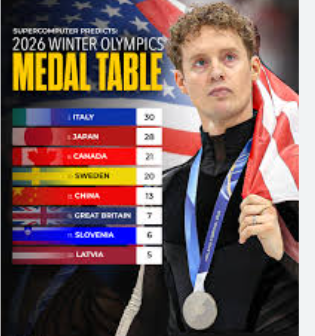
Based on historical trends, athlete pipelines, home advantage, and event-specific projections, the estimated top ten nations for the 2026 Winter Olympics are:
| Rank | Country | Projected Total Medals | Projected Gold Medals | Notes |
|---|---|---|---|---|
| 1 | Norway | 33–36 | 14–17 | Dominance in cross country and biathlon |
| 2 | United States | 22–28 | 9–12 | Strength in freestyle skiing, snowboarding, figure skating |
| 3 | Germany | 20–25 | 8–11 | Sliding sports and biathlon consistency |
| 4 | Canada | 25–30 | 8–12 | Ice hockey, freestyle skiing, rising stars |
| 5 | Italy | 15–20 | 3–5 | Home advantage, alpine skiing, short track |
| 6 | Switzerland | 10–14 | 3–5 | Alpine skiing, team events |
| 7 | Sweden | 8–12 | 2–4 | Biathlon and cross country |
| 8 | Netherlands | 6–10 | 4–6 | Speed skating specialists |
| 9 | Japan | 5–9 | 1–3 | Figure skating, short track |
| 10 | South Korea | 4–8 | 1–3 | Speed skating, short track relays |
These projections consider both predictable podiums and potential surprises from emerging athletes and nations. Medal totals may shift slightly based on last-minute injuries, weather variability, and the high-risk nature of judged events. The projected table reflects likely outcomes based on preparation, historical data, and current performance trajectories.
Conclusion
The 2026 Winter Olympics in Milan Cortina promises to be one of the most competitive and exciting Games in recent memory. Predicting medal counts is more than a hobby. It involves analyzing historical trends, emerging talent, environmental factors, home advantage, and volatility in judged and team events. Norway is projected to remain at the top, while the United States, Germany, and Canada are poised to compete fiercely for silver and bronze. Italy as host nation is expected to benefit significantly, and dark horse nations could disrupt expectations.
Understanding these dynamics provides valuable insight for fans, analysts, and betting enthusiasts alike. Whether tracking athlete pipelines, World Cup results, or environmental conditions, the early 2026 Winter Olympics medal count predictions offer a roadmap to the likely outcomes. The Games will test skill, strategy, and endurance, but historical patterns and careful analysis allow us to make informed projections.
Frequently Asked Questions
1. Which country is projected to win the most medals at the 2026 Winter Olympics?
Norway is expected to lead the medal table, particularly due to dominance in cross country skiing and biathlon.
2. How will Italy’s home advantage impact medal predictions?
Italy is projected to earn several extra medals due to familiar terrain, supportive crowds, and reduced travel fatigue, particularly in alpine skiing and short track.
3. What are the United States’ strongest medal prospects?
Freestyle skiing, snowboarding, figure skating, and ice hockey are expected to contribute the majority of the US medal total.
4. Which emerging nations could disrupt the medal table?
Sweden, Switzerland, Japan, South Korea, and the Netherlands are expected to capture unexpected medals, particularly in niche disciplines like speed skating, figure skating, and Nordic events.
5. How reliable are these 2026 Winter Olympics medal count predictions?
While projections are based on historical trends, athlete pipelines, and event-specific analysis, outcomes can shift due to injuries, weather, or unpredictable performance in judged or high-risk events.