

Football: Who invented the world’s most popular sport?
Football is by far the most popular sport in the world, and there are good reasons for that – loved by at least 265 million people worldwide, it’s easy to play in any backyard or field and feel an immediate connection with the players running in stadiums around the globe.
However, if you’re looking for the oldest ancestor of all those runs, kicks, and cooperation, get ready to travel back in time, spin the globe, and make sure you don’t lose your head – literally. We’ll tell you what you need to know about the ancestral origins of football.
The ancestral origins of football
The Chinese were the first to enjoy kicking balls into goals in the 3rd century BC , and the game known globally as football was formalized in England in the 19th century. However, the predecessor of all modern ball games can be found in the Americas.
“The idea of team sports was invented in Mesoamerica,” says Mary Miller, a professor of Art History at Yale University who has studied numerous pieces of evidence of sport.
A latex ball of Olmec origin, dating back approximately 3,000 years. It is unknown whether this ball was used for play or as a ritual ball. Considering its impeccable condition, it would likely be the latter.
In Mesoamerica, the vast historical region stretching from Mexico to Costa Rica, several civilizations flourished, and many of these peoples played a sport involving a heavy ball made from a substance derived from tree resin .
It is not known for certain where the game was invented, but it was popular among Mesoamerican cultures such as the Osotihuacans, Aztecs, and Mayans for about 3,000 years. Its name varied – ullamaliztli in Aztec, pok-ta-pok or pitz in Mayan – and so did the rules, including movements such as keeping the ball in play by touching it with body parts, rackets, or sticks.
Many of these games were played with seven-kilogram rubber balls , which still exist in the archaeological record. Other evidence ranges from ceramic vessels to more than 1,300 large stone courts that can be found throughout the region.
Aztec players passed the ball between teams using only their hips and buttocks (the use of feet and hands was forbidden). They tried to reach the back of their opponents’ court with just one touch of the ball, often suffering potentially fatal injuries when struck by the heavy, hard ball. If a player managed to get the ball into a hoop set up at a certain height in the opposing team’s court, victory was automatic – and a great honor for the winner.
Making sacrifices
Although it was an everyday sport, like football or basketball are now, this ball game also played a sacred role in the religious and warlike practices of Mesoamerican cultures. Aztec kings allegedly played it as a substitute for war, winning governing rights or resolving diplomatic disputes with a ball game. In Mayan and Veracruz cultures , there was even more at stake: those defeated in some ritual games were sacrificed.
We don’t know the details, but some fields are decorated with panels depicting the bloody sacrifice of defeated players . Sacrifice and sport were also closely related in a Mayan creation myth, which shows a pair of twins defeating the lords of the underworld in a ball game – they end up transforming into the Sun and the Moon.
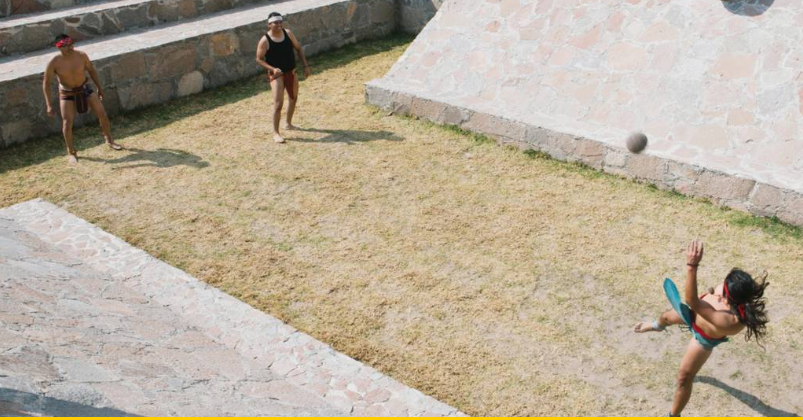
Long before basketball and soccer, the ancient Maya gathered on the field for the Mesoamerican ballgame. Today, in Hidalgo, Mexico, a group of athletes is determined to bring back this ancestral ballgame and honor the traditions of their ancestors.
Despite evidence that the defeated were sometimes literally eliminated, Miller says, some 20th-century archaeologists refused to believe that any players except the winners were killed. “They couldn’t believe that the Maya practiced human sacrifice,” he said. “Now we know that’s nonsense, just like the idea that any victorious player would be sacrificed.” In Mayan mythology, the loser of the ball game is decapitated , and today scholars generally agree that it was the losers, not the winners, who faced death.
British schools invent a new version
Although other cultures, such as Native Americans and Indigenous Australians, played similar games, the sport now known as football (soccer) originated in British schools . While variations of the game had been played informally for centuries, the sport was formalized in the 19th century.
In the mid- 19th century , developments in transport, work, and technology gave people the free time and means to travel and attend competitive games on grass fields . In the 1840s, a number of British schools created their own rules of play, enabling the organization of tournaments between players who knew the same rules.
Over time, two different sets of rules came to dominate the sport. Sheffield Football Club offered teams an extra kick if the opponent disobeyed the rules of the game, and Cambridge University prohibited players from carrying the ball with their hands.
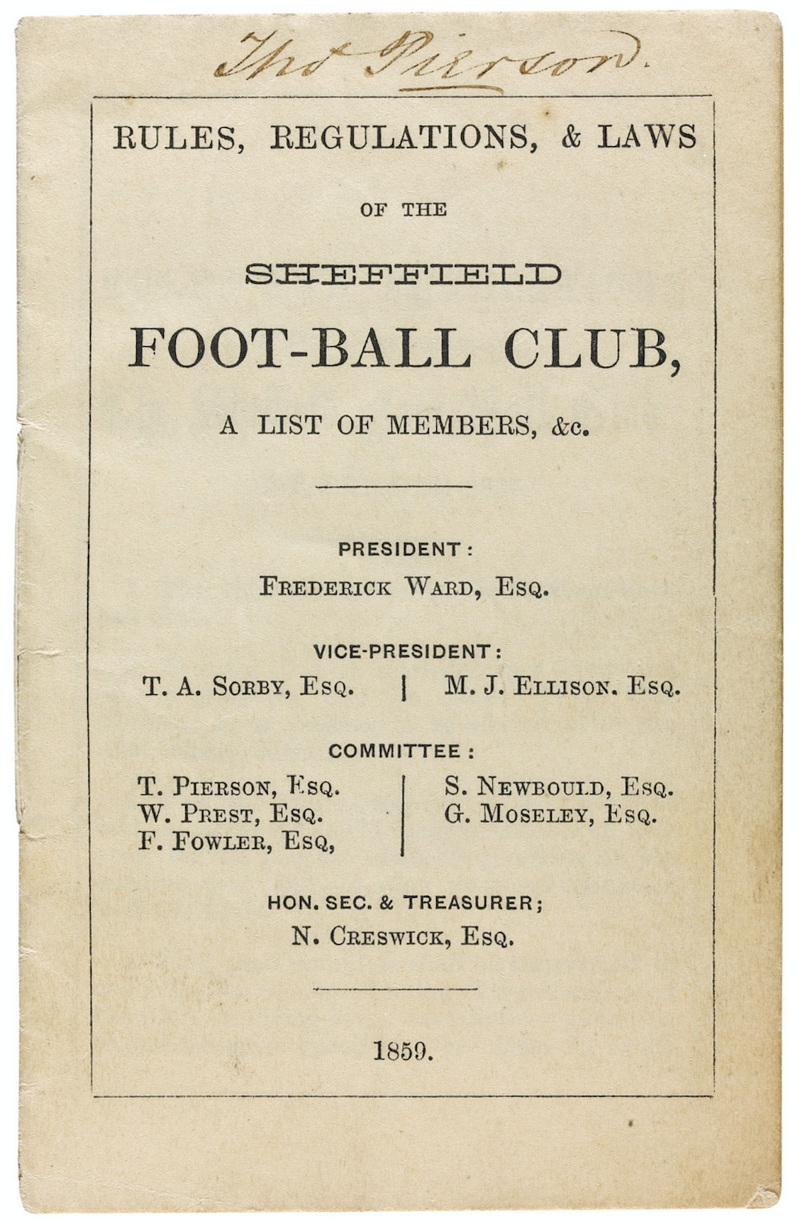
Front page of “Rules, Regulations, and Laws of Sheffield Foot-Ball Club, a list of members, etc.” Sheffield: Pawson and Brailsford, 1859, first edition, 16mo (122 x 77 mm), the only known copy of the first printing of the laws of the first football club.
As the sport’s popularity grew, players banded together, forming the London Football Association . In 1877, Sheffield officially adopted the so-called “London rules.” By this time, some teams had already begun recruiting players, secretly paying working-class league members.
Footballers from the upper classes wanted the sport to remain amateur. In 1885, however, they finally agreed to the existence of professional players, allowing for a new leap in the sport. By 1904, the sport was so popular that it had become international. The Fédération Internationale de Football Association (FIFA) was created that same year.
Football today
The success of football skyrocketed from this point. After the sport’s debut at the 1908 Olympic Games and the first FIFA World Cup in 1930, professional football flourished. FIFA continues to be the governing body of the sport, having generated 755.5 million in revenue in 2021 alone.
However, the heart of the game has always been the pitch, where everyone, from young children to seasoned professional athletes, can have fun in action. The spirit of football, which Miller describes as an “intricate team reasoning,” is alive and well in modern versions of the ball game and among the millions of amateur and professional players who run, dribble, and kick the ball on official or improvised pitches every day.